
Published: 15 Jan 2026
Think about your own venue – how are you currently getting a visitor's attention?
You have incredible stories to tell, but venues like yours are often limited by the physical space. For years, the default solution was the "interpretive panel" - a static board that’s expensive to print, impossible to update and often ends up as part of the furniture that visitors simply walk past.
Your story deserves more than a flat piece of foam board. At ATS we create modern digital solutions that your visitors will actually love to use. The goal isn't just to show information; it’s to invite an audience into the story. The most effective, versatile and budget-friendly way to do that? The interactive tablet kiosk.
Traditional interpretation has a major flaw: it’s permanent. If you want to update information about an artefact, or even swap a display for a seasonal event, a printed sign becomes instantly outdated.
Then, there is the hidden headache of the paper leaflet. While they’ve been a heritage staple for decades, the practicalities are becoming harder to justify:
Interactive kiosks change the dynamic entirely. By moving into a digital format, you create a living, breathing exhibition. You can host hundreds of high-resolution images, layered maps and hours of video content, all within a small footprint.
It’s about offering depth on demand: if a visitor wants a two-minute overview, they can have it. If they want to spend twenty minutes digging into the architectural blueprints of your building, the kiosk is ready for them.
We know what you’re thinking: "Technology in a public space? That sounds like a maintenance nightmare."
We’ve heard it all before, which is why ATS’s retail-grade kiosks are built for the rigours of the heritage sector. These aren’t just tablets stuck to a wall with some sticky tape. They are secure, robust and designed to be completely tamper-proof.
Our hardware is engineered to withstand high-traffic environments - from curious toddlers to busy tour groups. The tablets are locked within the housing, ensuring a focused user experience.
You don’t have to worry about visitors accessing the internet or changing the settings. Whether you need a sleek, wall-mounted unit for a tight corridor or a freestanding pedestal that acts as a focal point in a gallery, the hardware is as adaptable as the software it runs.
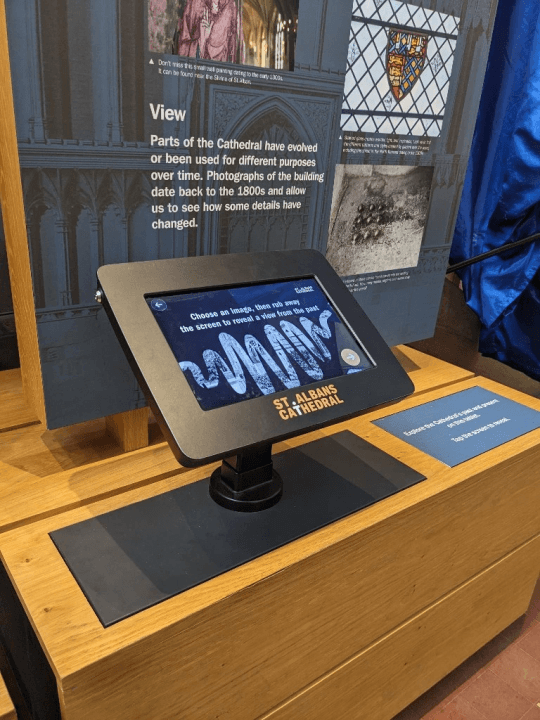
St Albans Cathedral is a site of immense historical significance, standing as the oldest site of continuous Christian worship in Britain. The challenge was clear: how do you show centuries of evolution without cluttering a sacred space?
The solution was a permanent, branded kiosk featuring one of our most popular digital tools: the "Rubaway." We worked closely with the St Albans team to design a bespoke app that felt like a natural extension of their storytelling.
The kiosk allows visitors to see a modern-day view of the Cathedral grounds and, with a simple swipe of their finger, "rub away" the present to reveal the historical "before" view underneath.
It’s tactile, intuitive and remarkably effective. It has been a massive hit with younger audiences, providing a visual "wow" factor that a traditional leaflet simply cannot replicate.
ATS managed everything from the initial consultation to the hardware assembly and final installation, providing a seamless transition from "idea" to "interactive."
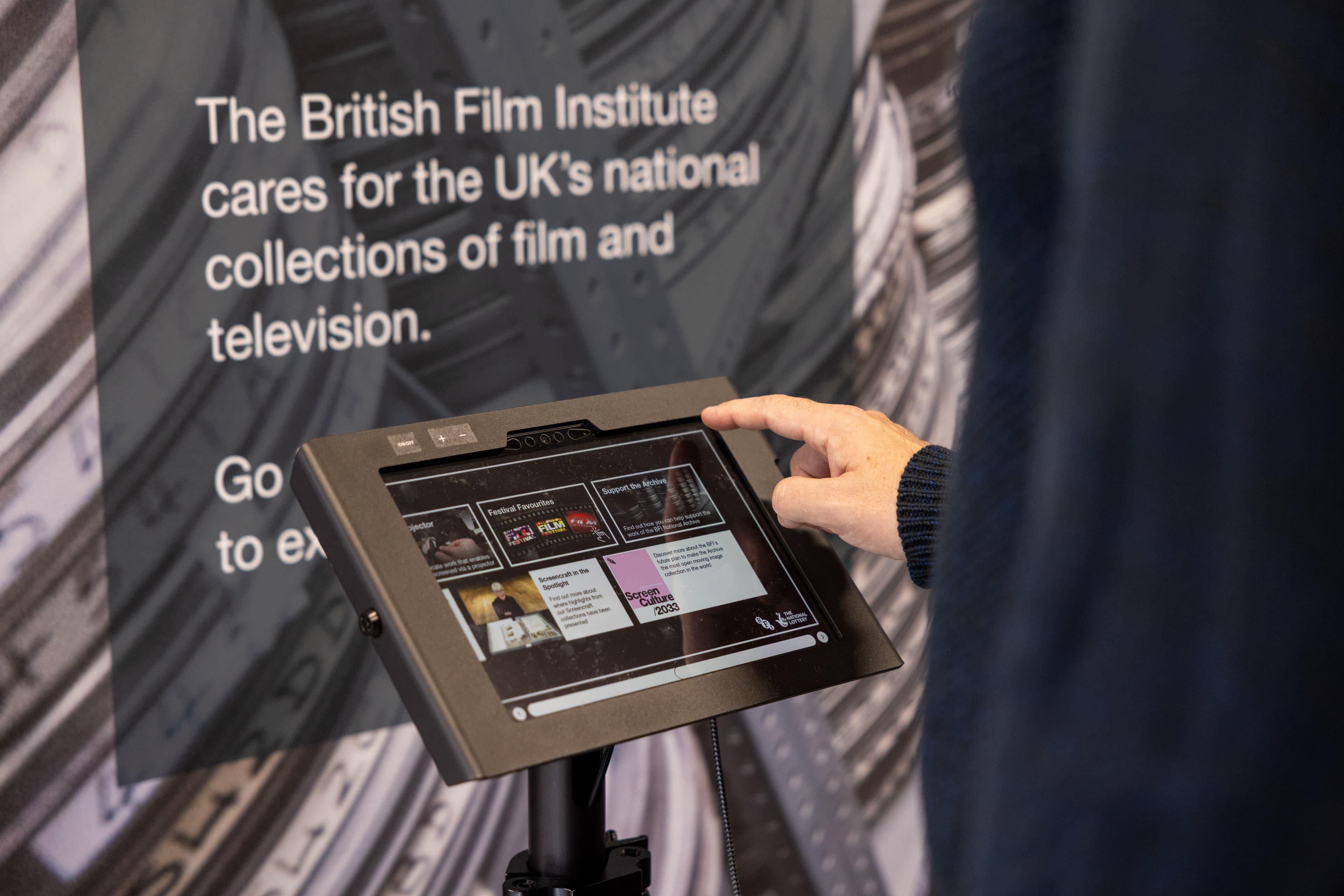
While St Albans needed a permanent fixture, the British Film Institute came to us with a completely different set of requirements. They needed a high-tech exhibition that needed to tour the UK, popping up in libraries, community cinemas and arts centres for as little as a day at a time.
This project required a masterclass in portable design. The BFI’s "Inside the Archive" exhibition needed to be lightweight, easy to move, and simple enough for non-technical venue staff to set up.
How we made the BFI’s vision mobile:
A common misconception is that this level of digital engagement is only for "big" national museums with endless funding.
Spencer Clark, Managing Director of ATS, is quick to point out that kiosks are actually budget friendly:
“Heritage sites with limited budgets find the tablet kiosk provides contemporary interpretation at a low price point. It’s actually more sustainable than print. If your story changes, you update the software, not the physical signage. It’s rugged, it’s flexible, and it brings a ‘modern’ feel to any venue instantly.”
At ATS, we offer two paths to going digital. You can opt for a bespoke app, designed from the ground up to your exact specifications, or you can use our flexible templates. These templates allow you to plug in your own audio, video, and images (including the Rubaway feature) into a proven, user-friendly interface that’s ready to go.
The versatility of the ATS kiosk extends far beyond storytelling. While their primary job is interpretation, they can also serve your venue as:
Visitors want to be more than just a spectator; they want to be part of the discovery. By moving away from static print and embracing interactive kiosks, you aren't just adding a piece of tech, you’re opening a window into the hidden details of your site.
Whether you need a permanent installation like St Albans or a touring, "pop-up" solution like the BFI, ATS has the expertise to bring your archive to life.
Contact the ATS team today to discuss your next project.
Photos by Millie Turner.